

If you work in Infrastructure & Operations, you probably know the feeling: a major migration lands on your desk, and suddenly you’re managing pressure from every direction. Timelines. Compliance. Legacy tech. End users who absolutely cannot lose access. And an ever-growing list of unknowns and subsequent risks.
According to Gartner,
“Data migration projects are one of the most challenging undertakings for any organization, irrespective of their size or technical maturity. These projects might appear simple and straightforward on paper, as they primarily involve moving data from a source system to a target system. However, in reality, they frequently exceed budgets, miss deadlines or fail to meet quality requirements.”
At bluesource, we’ve spent nearly two decades turning that stress into something predictable, structured, and set up for success. We’ve migrated data for organisations in some of the most heavily regulated sectors including; legal, financial services, construction and healthcare, and the challenges are often similar. But so is the relief when customers realise that migrations can run smoothly.
Whether you’re looking for a migration partner or planning to go it alone, there are key considerations for a successful outcome.
Every Migration Is Different
Data health varies. Retention rules differ. Infrastructure maturity is unpredictable. Regulations are strict. Source and target applications vary. And business pressures never disappear.
There’s no cookie‑cutter migration, and that’s exactly why experience matters.
As migrations don’t happen every day in your business, it’s unlikely that your internal teams will have knowledge and expertise of both your source and target systems to deliver a seamless migration.
When each stage is handled by people who’ve done this hundreds of times, the entire experience becomes; faster, less risky, more predictable, easier on your users and kinder on your teams.
Best Practices for Data Migration Success
Organisations migrate data for a variety of reasons including modernisation, gaining new capabilities, efficiency gains, aligning to evolving strategy, platforms and their support reaching end of life, or mergers or acquisitions. In the current climate migrations are also being prompted by concerns over data sovereignty, shifting geo-politics and price increases.
Regardless of the rationale for change, successful migrations can be achieved when following a clear blueprint. Gartner® identifies four distinct stages; plan, design, develop and deliver.
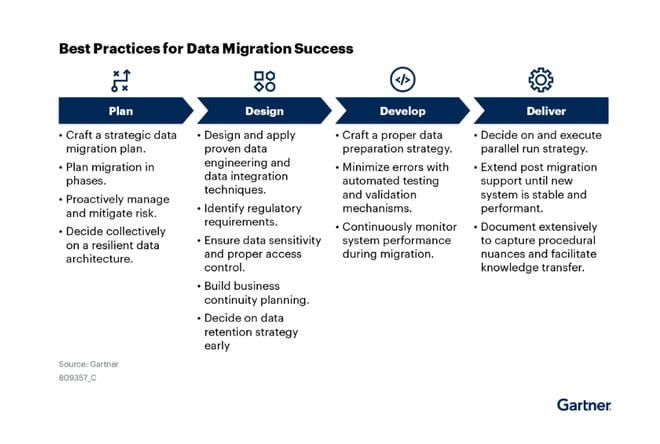
Gartner, 15 Best Practices for Successful Data Migration, By Masud Miraz, Henry Cook, Melody Chien, 7 April 2025.
Gartner is a trademark of Gartner, Inc. and/or its affiliates.
Limited time complimentary access to Gartner’s 15 Best Practices for Migration Success has come to an end. You will now need a Gartner subscription to view the report.
In our view, these best practices by Gartner® reflect the insights we have gained from over 20 years of practical experience delivering well-managed and efficient migrations.
Your Environment is Unique, so Choose your Tools Wisely
If you search for migration tools online, it’s easy to come away convinced that any one of them is a silver bullet. But the truth is: no single tool is the right answer for every organisation.
The right tool for you will be dependent on a range of factors, such as your retention model, your data health, your compliance needs, as well as your source and target environments.
When working on a migration, you need to consider all the unique aspects of your migration to select the tool that genuinely fits the job. At bluesource, we don’t push a predefined stack, we’re vendor agnostic. That’s how we keep risk low, efficiency high, and surprises to a minimum.
Surface Problems Before They Become Project Risks
Identifying problems early, can help prevent headaches and failures down the road. One missing item could be the difference in:
- A litigation case
- A compliance audit
- A financial dispute
Experience of the source and target systems, and migrations in general, can help to spot common issues in advance, and structured pilots can stress test the planned approach and provide realistic speed and timeline projections as well as determine the most cost-effective strategy.
Things to look for include:
- Environmental bottlenecks
- Network constraints
- Throttling behaviours
- Data integrity issues
Dedicated Project Management Protects the Whole Organisation
Migrations typically don’t fail because of technology. They fail because of misalignment: missed dependencies, poorly communicated change, unexpected access requirements, or sudden compliance asks.
If you're working with a migration partner, project managers on both sides can ensure the project runs smoothly.
Your PM and your partner's PM work side-by-side to:
- Ensure migration is not impacting user productivity
- Maintain compliance workflows
- Coordinate legal, risk, and operational teams
- Manage sequencing
- Surface risks early
- Maintain project rhythm from kick-off to completion
- Highlight limitations when migrating data from the source to the target and any optional workaround or considerations
If your data estate is complex (and whose isn’t?), this partnership is what keeps everything moving to plan. That’s why all bluesource migrations include an experienced Project Manager as standard.
User Experience Shouldn’t be an Afterthought
Minor disruption can have major consequences, especially in highly regulated industries. A legal team that can’t retrieve case files. A financial institution locked out of historic transactions. A construction firm needing decades-old engineering records to support safety investigations. These are all real-world requirements.
A key principle is; users never lose access. Ever.
Running old and new environments in parallel, ensures continuity. For some projects, this may mean users have temporarily have access to data in both locations, helping them test, confirm, and transition without anxiety.
Providing the right communication at the right time can help to ensure users are kept in the loop and know how to access the information they need at each stage of the process.
Expert Support for a Seamless Experience
Using migration experts, such as bluesource, allows you to avoid the steep learning curve and delays associated with learning as you go. But you remain in control. We don’t delete any of your data.
With 20 years of experience, we’re confident we can deliver a successful migration, no matter how large or complex. We’ve moved more data than most organisations will handle in a lifetime. To give you a sense of scale:
We move around 400 TB of just email archived data every year. That’s the equivalent to the entire Marvel Cinematic Universe… 400 times
Since we’ve been delivering migrations, that’s 7 petabytes. Or, the entire catalogue of Netflix UK more than 350 times.
Whether you're moving archives, email, file data, cloud workloads, or entire digital estates, we can help you plan a route that avoids the stress, risk, and uncertainty that often accompany migration projects.
Plan your next migration with confidence. Get practical, vendor‑neutral guidance and discover how to reduce risk, avoid delays, and protect user experience.
Most popular

Building the future of IT service desk efficiency with Retrieval-Augmented Generation (RAG)

The countdown to SharePoint end of life: Insights from our migration readiness webinar